|
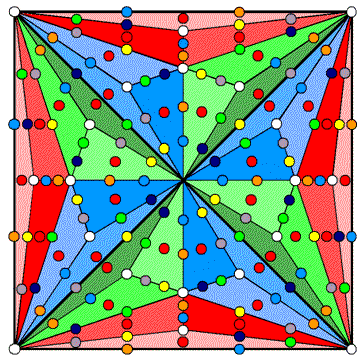
The inner Tree of Life basis of the independently predicted 2016 circular |
The Type A polygon is a polygon (not necessarily regular) whose n sectors are tetractyses; 6n yods surround its
centre. A Type B polygon is one whose n sectors are Type A triangles; 15n yods surround its
centre. A Type C polygon is one whose sectors are Type B triangles; 42n yods surround its centre. In general,
(3N/2)(1 + 3n) yods surround the centre of the nth-order N-gon (for proof of these formulae, see
analysis leading to Table 9 in Article 65). For the basic N-gon, n = 0; for the Type A N-gon, n = 1; for the Type B
N-gon, n = 2; for the Type C N-gon, n = 3. The total number of yods surrounding the centres of the seven
separate Type C polygons with 48 corners that make up each half of the inner Tree of Life
= 42×48 = 2016 (see also Table 3 in Article 60). As Table 2 in that article indicates, these seven separate polygons
comprise 1344 points, lines & triangles surrounding their centres. This number is the number of yods that
are intrinsic to the 14 enfolded Type B polygons of the inner Tree of Life and surround their centres. This is
because their 1370 yods contain 26 yods that are shared with the outer Tree of Life, where
26 is the number value of YAHWEH, the Godname of Chokmah, leaving 1344 unshared yods. The
inner Tree of Life with Type B polygons can therefore be said to encode its
geometrical composition when its polygons are Type C. Notice that:
1344 = 4×336 = 4×4×84 = 42(41 + 42 + 43) = 43 + 44 + 45
and that
1344 = 42(12 + 32 + 52 + 72) = 42 + 122 + 202 + 282,
i.e., 1344 is the sum of the squares of the first four integers that start with 4 and are eight units apart.
What is so special about the Type C polygon? As the 4th-order n-gon, it is the fourth of the infinite number of possible transformations of a polygon in which every triangle in the nth-order N-gon divides into its three sectors, forming the (n+1)th-order N-gon:
Polygon → Type A → Type B → Type C, etc.
According to the Tetrad Principle proposed by the author in Article 1, the fourth member of the infinite class of mathematical numbers or geometrical objects always represents a cosmic parameter that characterizes matter at the fundamental level. Some of these special numbers will have already been found by theoretical physics. But others are yet to be discovered. Therefore, the principle helps to establish the fundamental significance of any parameter predicted by some theory, although it by no means gives suport to it, as its criteria are necessary but not sufficient. Simple, arithmetic examples of the principle are:
1, 1+2=3, 1+2+3=6, 1+2+3+4=10, etc,
in which the fourth member is 10. This is the number of dimensions of space-time, according to superstrong theory;
12 = 1, 22 = 4, 32 = 9, 42 = 16, etc.,
in which the fourth member is 16, which is the number of dimensions beyond 10-d superstring space-time that are required by bosonic string theory;
1, 3, 5, 7, etc.,
in which the fourth member is 7, which is the number of compactified dimensions required by M-theory, the parent theory of superstring theory;
13 + 33 + 53 + 73 = 496,
where 496 is the dimension of the symmetry group E8×E8 that describes the unified force acting between one of the two types of heterotic superstring.
In a geometrical context, the principle is examplified by the fourth type of square — the Type C square, whose centre is surrounded by (4×42=168) yods:
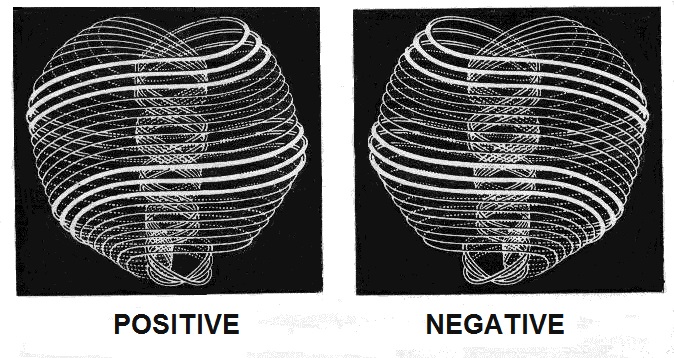
168 is the gematria number value of the Mundane Chakra of Malkuth (see here), which, as the last of the 10 Sephiroth, signifies the outer, material form of anything conforming to the Tree of Life blueprint. According to Annie Besant and C.W. Leadbeater, two early leaders of the Theosophical Society, the basic unit of matter (what they called the "ultimate physical atom," or "UPA"), is a set of 10 helices ("whorls"), each one consisting of 1680 circular turns that wind five times around its axis of spin, 336 turns per
|
|
|
|
|
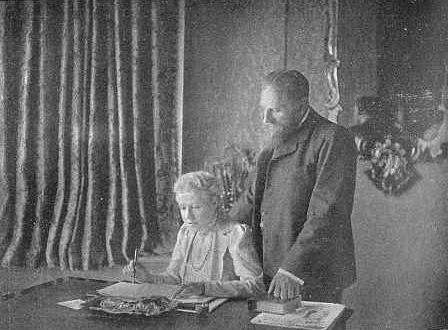
Annie Besant & C. W. Leadbeater |
The two chiral forms of the UPA. |
Each of the 10 whorls of the UPA is a helix with 1680 circular turns counted by Leadbeater. |
|
|
|
|
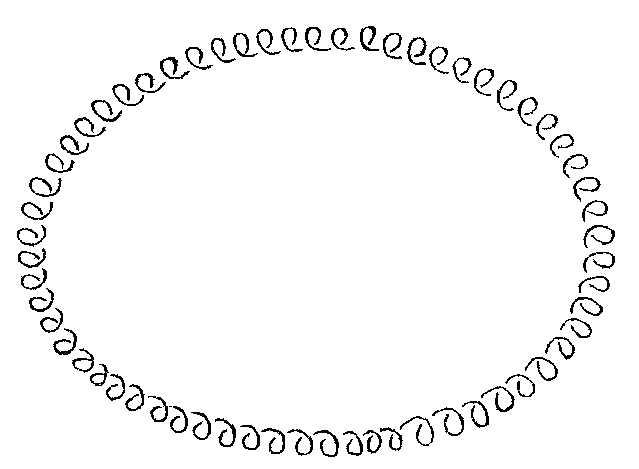
| Ronald D. Cowen | The basic unit of the pranamaya kosha, as drawn by Cowen. The author predicts that this is the basic constituent of dark matter. (From: The Path of Love, FriesenPress, Canada, 2015). |
Each of the 5 whorls in Cowen's particle is a helix predicted to have 2106 circular turns. |
revolution and 168 turns per half-revolution. The Type C square therefore embodies the very number of turns in a half-revolution of a single whorl of the particle that the author identified in 1980 in his book Extrasensory Perception of Quarks (download here) as the subquark constituent of up and down quarks and then in 1999 in his book ESP of Quarks and Superstrings (download here (Ch. 1-4) & here (Ch. 5-6)) as an E8′-singlet state of the E8×E8′ heterotic superstring.
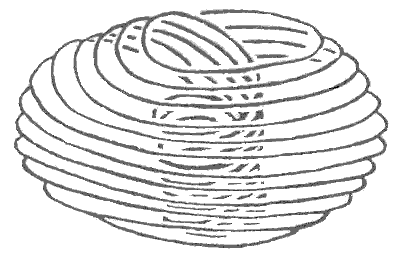
What makes the inner Tree of Life unique when its polygons are 4th-order, i.e., Type C, is that the number 2016 is independently predicted by the author to be the number of circular turns in each of the five whorls making up the particle that Ronald D. Cowen, a Canadian Buddhist, remote-viewed during the 1990s, claiming in his book The Path of Love (see here) that it is the basic constituent of an invisible, highly organised matrix of subtle matter or energy that yogis call the "pranamaya kosha." This is the second of the five koshas (sheaths) in yogic philosophy, also known as the "energy sheaf" or "vitality body." These koshas are the vehicles of consciousness that function in the lowest five of the seven planes of consciousness: The current and original Theosophical names of these planes are:
|
Current |
Original |
|
| 1. | Divine Plane | Adi Plane |
| 2. | Monadic Plane | Anupadaka Plane |
| 3. | Spiritual Plane | Atmic Plane |
| 4. | Intuitional Plane | Buddhic Plane |
| 5. | Mental Plane | Mental Plane |
| 6. | Emotional Plane | Astral Plane |
| 7. | Physical Plane | Physical Plane |
See here (# 5) for how the inner Tree of Life encodes the seven planes (as
preparation, reading of earlier pages of this section will be needed). If one searches for pictures of the
pranamaya kosha with an internet search engine, one finds that they are almost all
purely schematic representations. This is because one needs activation of what is known in yoga as the
ajna chakra (commonly known as the "third eye") in order to discern its complex
structure, but very few people have even accomplished this, let alone used their new vision to draw the kosha.
The Theosophists Annie Besant and C.W. Leadbeater claimed to have acquired this ability (see here), and they described the pranamaya kosha in
various books, calling it the "etheric double." Through a breakthrough he made in the 1990s in certain advanced
forms of Buddhist meditation, Cowen professed to have developed a similar ability. He even claimed in his book
to relate the complex states of the basic constituents of the invisible matter in this
kosha revealed by his psychic vision to enigmatic passages about the nature of consciousness that
appear in the Theravada Abhidharma. This is a highly systematized framework of
Buddhist psychology and ethics to be found in the Pali Cannon.
The fact that 2016 yods surround the centres of the fourth class of polygons that make up the inner Tree of Life
means that each yod symbolises a circular turn of a whorl in Cowen's particle. It would, however, be more accurate
to state that a yod denotes one of the two mutually perpendicular plane waves whose vibrations 90
degrees out of phase generate a circularly polarized oscillation. The 2016 yods surrounding the centres of the
seven Type C polygons in one half of the inner Tree of Life symbolise one set of 2016 plane waves, whilst their
mirror-image counterparts — the 2016 yods surrounding the centres of polygons in the other (reversed) half of the
inner Tree of Life — denote the second set of 2016 plane waves in each whorl.
 |
 |
 |
 |
 |
 |
(Place cursor over each polygon to transform it into a Type C polygon)
As 2016 = 48×42 and 1680 = 40×42, their difference = 336 = 8×42, which is the number of yods surrounding either the centre of the Type C octagon or the centres of the Type C triangle and the Type C pentagon (there is no other combination of polygons with eight sectors). Besant & Leadbeater wrote in their book Occult Chemistry (download here the PDF version of its third edition) that each helical whorl in the UPA revolves five times around its axis of spin, each revolution being composed of 336 turns. Responding to my question about how many times a whorl spirals aound the axis of the particle Cowen had discovered by remote-viewing particles in his own pranamaya kosha, he reported that it made six revolutions, although he never tried to emulate Leadbeater's feat by counting how many turns each whorl has. His drawing of a whorl of the particle in Figure 38 of his book depicts three outer, 360° spirals and three narrower, 360° spirals forming its core. The 336 yods in the Type C octagon symbolise the 336 turns in the extra revolution of a whorl in his particle. The seven Type C polgons represent the oscillatory nature of the helical whorl belonging to both this particle and the UPA.
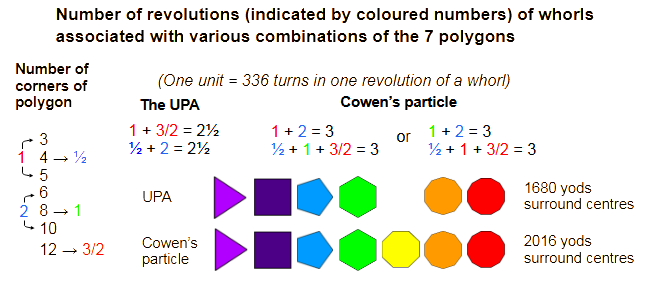
The octagon with 336 yods provides a convenient unit for measuring the yod populations of the other polygons. The seven polygons have 48 sectors with the yod population of six octagons (six units), so that the six polygons other than the octagon that have 40 sectors with 1680 yods and represent the whorl of the UPA are equivalent to five octagons (five units). The diagram shown above indicates that the triangle, pentagon & dodecagon have 2½ units, whilst the square, hexagon & decagon also have 2½ units. As each unit represents a whole revolution of a whorl — whether in the UPA or Cowen's particle — this reproduces the outer and inner halves of the UPA, each half making 2½ revolutions around its axis. Notice that these combinations of polygons are unique — no other combination generates this 2½:2½ division of units. The triangle, pentagon, hexagon & decagon contain three units of yods, as do the square, octagon & dodecagon; this is the first possibility listed under Cowen's particle in the diagram shown above. This reproduces the outer and inner halves of Cowen's particle, each half making three revolutions around its axis. However, one other set of combinations has the same 3:3 division, namely,
triangle, square, pentagon & dodecagon
hexagon, octagon & decagon.
(this is the second possibility shown in the diagram above). The two possible combinations arise because there are two possible "1"s arising from the fact that the triangle and pentagon have the same number of corners as the octagon. This allows the two "1"s to exchange places to create two different combinations. It might be thought that considerations other than purely numerical ones must decide which is the correct one. But this is not the case for the following reason: the numbers of sectors (42 yods per sector) associated with each particle are:
UPA: (3+5+12) + (4+6+10) = 20 + 20 = 40;
Cowen's particle (1st option): (3+5+6+10) + (4+8+12) =
24 + 24 = 48;
Cowen's particle (2nd option): (3+4+5+12) + (6+8+10) = 24 + 24 = 48.
Article 64 established that only the combination of polygons in the second option generates the two mathematical halves of the set of seven enfolded polygons that make up each half of the inner Tree of Life. Intuitively speaking, it seems correct to identify these two halves with the outer and inner halves of Cowen's particle, given that the whole set of seven polygons represents the latter. Consistency with this earlier work therefore requires that the second option be regarded as the correct one.
The complete set of seven Type C polygons in each half of the inner Tree of Life contain six units of yods (one unit = 336 yods). The 2016 yods surrounding its centres symbolise the 2016 turns that the author predicts to make up each whorl in Cowen's particle. The six polygons other than the octagon (one unit) contain five units of yods, i.e., 1680 yods surrounding their centres. They symbolise the 1680 turns in each whorl of the UPA. The 6:5 ratio expresses the six revolutions in the former type of whorl and the five revolutions in the latter type. It manifests in the outer Tree of Life whenever its trunk is distiguished from its branches. The UPA — the basic unit of ordinary, physical matter — constitutes the trunk of the microscopic Tree of Life, whilst Cowen's particle — the basic unit of the pranamaya kosha — is its life-sustaining branches (see here for the definitions of "trunk" and "branches" in this context). One may think of one half of the inner Tree of Life as the branches and the six polygons in its other half as its trunk. The author's hypothesis (as yet unchecked by any new micro-psi observations) that the whorls in both types of particle have the same number of turns per revolution finds confirmation in the emergence of the same 6:5 proportion that exists in the geometry of the outer Tree of Life and its polyhedral counterpart, namely, the 144 Polyhedron, which has 72 vertices surrounding its axis, 216 edges & 144 faces, and the disdyakis triacontahedron, which has 60 vertices surrounding its axis, 180 edges & 120 faces:
72/60 = 216/180 = 144/120 = 6/5,
as well as in the inner form of the Tree of Life as the distinction between the boundary of the seven enfolded, Type A polygons, lined by 120 yods, and their interiors, which contain 144 yods, where 144/120 = 6/5 (see here for details of how the Polyhedral Tree of Life is encoded in the polygons of the inner Tree of Life). The 144 Polyhedron is the polyhedral form of the branches of the Tree of Life and the disdyakis triacontahedron is the polyhedral form of its trunk.
Each of the five whorls of Cowen's particle is mapped by a single Tree of Life, whose inner form consists of six units of yods (unit ≡ 8 sectors). The five Trees mapping the particle have an inner form containing 30 units, or 240 sectors. As the Lie gauge symmetry group E8 has 240 roots, each associated with a gauge charge of this group, a sector of a polygon with 42 yods represents a single gauge charge. This means that a gauge charge is spread along every 42 turns in a helical whorl, every revolution carrying eight such charges. The resulting factorisation of 240:
240 = 5×6×8 = 30×8
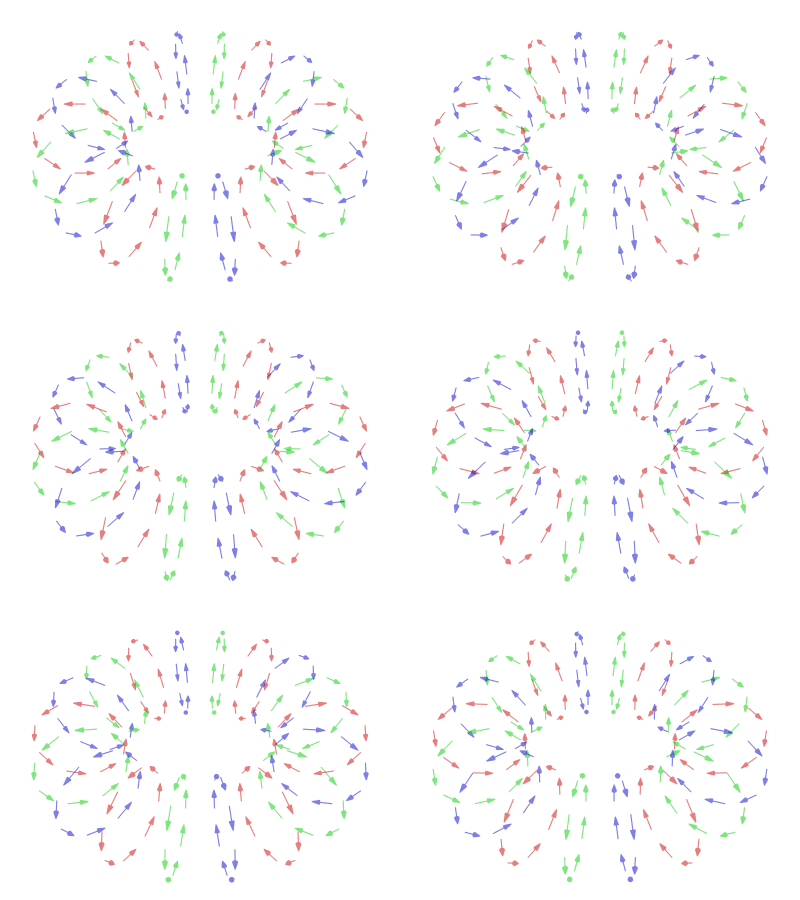
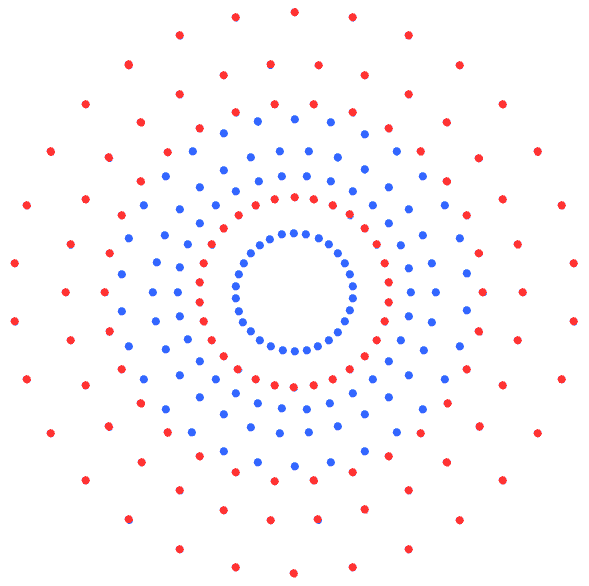
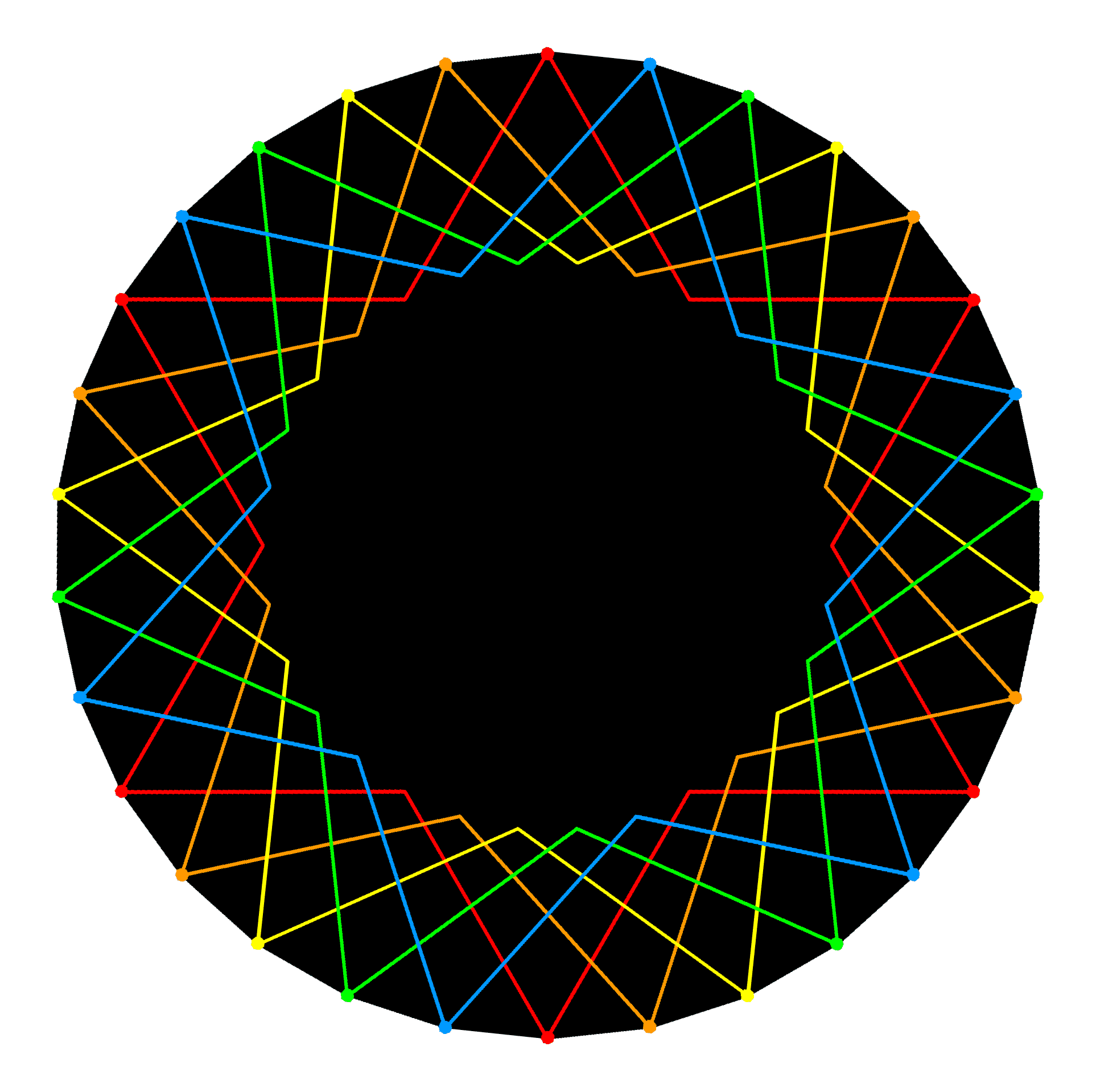
has its counterpart in the 8-dimensional 421 polytope, whose 240 vertices represent these 240 roots. When projected into 4-dimensional space, this polytope has a particular projection in which its vertices appear arranged at the 240 corners of eight concentric, similar, regular polygons called triacontagons, each with 30 corners. The triacontagon is known to be the so-called "Petrie polygon" for the E8 Coxeter plane projection of the 421 polytope. The 120 red vertices in four triacontagons are the projected vertices of a 600-cell; the remaining 120 blue vertices of four other triacontagons are the projected vertices of another, smaller 600-cell. This polychoron is discussed in #1 of Polychorons & Gosset polytope. The 30 corners of each triacontagon are the corners of five hexagrams, so that there are eight sets of five hexagrams (see further discussion here). The
.png "Coxeter plane projection of the 421 polytope") |
 |
 |
|
Coxeter plane projection of the 240 vertices of the 421 polytope. |
The 8 triacontagons are the Petrie polygons of two 600-cells. The larger one has 120 red vertices and the smaller one has 120 blue vertices. |
The 30 corners of the triacontagon mark out five hexagrams. |
following correspondences exist between the inner form of five Trees of Life, the projected vertices of the 421 polytope and Cowen's particle:
factor of 5: Tree of Life ↔ hexagram ↔ whorl (observed);
factor of 6. unit ↔ corner of hexagram ↔ revolution of whorl (observed);
factor of 8. polygonal sector ↔ layer containing triacontagon ↔ 42 turns per 1/8th revolution (predicted)..
These correspondences occur because the sacred geometry and the pure mathematics refer to the same thing,
as illustrated by Cowen's remote-viewing of particles that made up his own
pranamaya kosha.
Summary of the inner Tree of Life representation of the whorls of the UPA & Cowen's particle
|
Cowen's particle |
 |
2016 yods surrounding centres of 7 polygons → 2016 turns in whorl. | ||||
|
Cowen's particle |
|
|
2016 pairs of yods → 2016 pairs of orthogonal plane waves in whorl. | |||
|
UPA |
 |
1680 yods surrounding centres of polygons other than octagon. | ||||
|
UPA |
.png "6 polygons other than octagon (rev)") |
|
1680 pairs of yods → 1680 pairs of orthogonal plane waves in whorl. | |||
|
Cowen's particle |
|
|
(2016+1680) yods in 13 polygons → (2016+1680) turns in whorls of Cowen's particle and the UPA. | |||
|
|
|
|
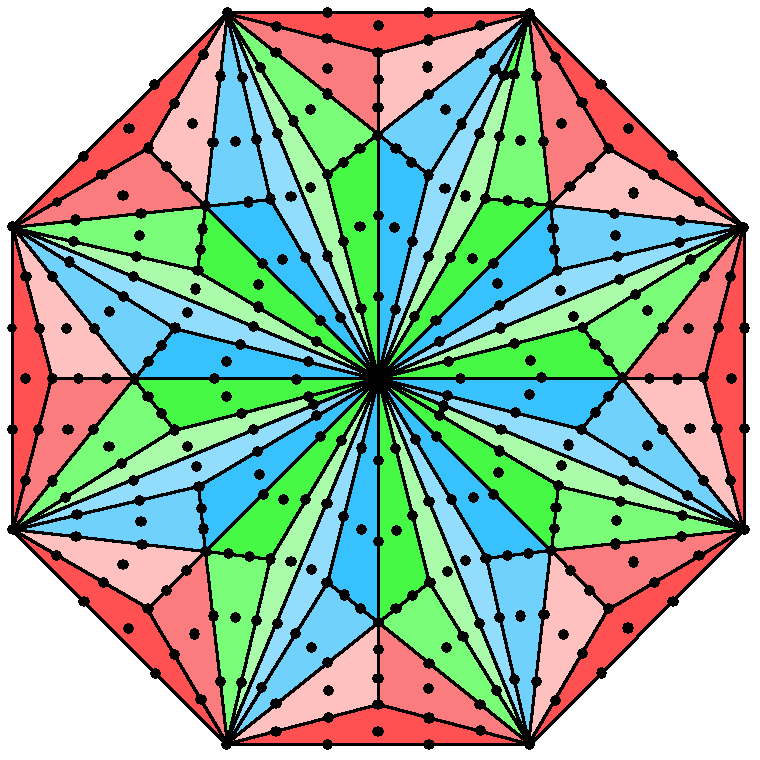
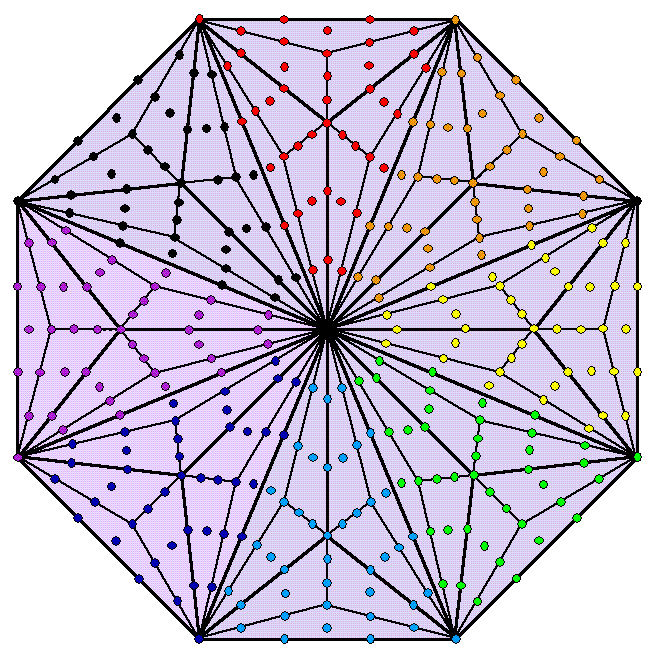
336 yods surround the centre of the Type C octagon. |
336 circular turns are predicted to make up each revolution of the helical whorl in both the UPA (E8′-singlet, subquark state of the E8×E8′ heterotic superstring) and Cowen's particle (an E8-singlet state of this superstring and the basic unit of dark matter). |
The factorisation:
336 = 8×42
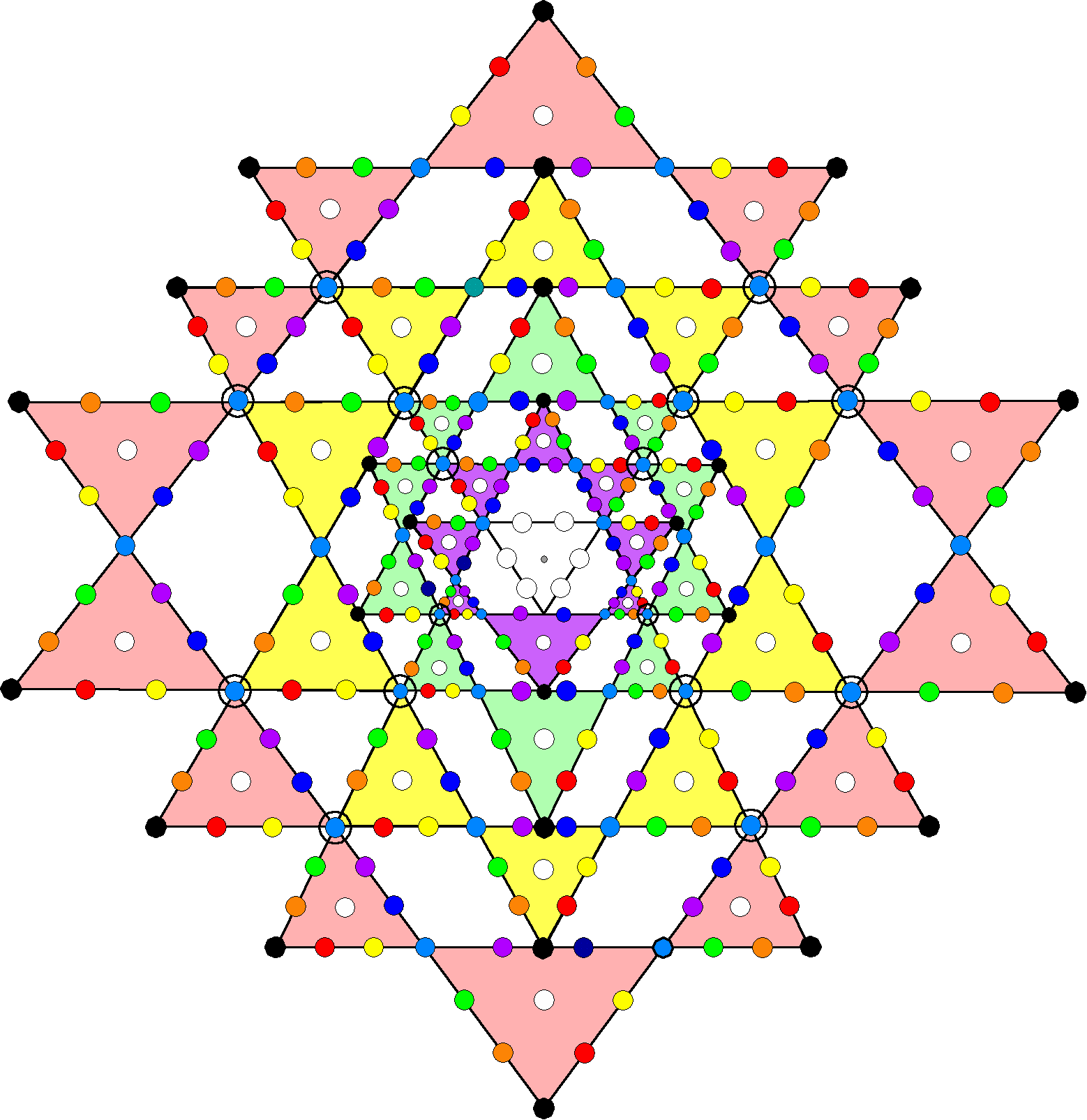
displayed in the Type C octagon (eight sectors, 42 yods per sector) is also exhibited in the three-dimensional Sri Yantra. When the 42 triangles in its four layers are turned into tetractyses, each of their central yods is surrounded by nine yods lining their boundaries. Each triangle is linked at two corners to adjacent triangles in the same layer. This means that there are eight yods per tetractys lining its sides. Hence, the number of yods on the boundaries of the 42 triangles = 8×42 = 336. This number shapes the three-dimensional Sri Yantra in the same way that it measures the oscillatory form of of each revolution of a helical whorl in both the UPA and Cowen's particle. Every yod of a given colour is repeated 42 times, just as it is in each sector of the Type C octagon.
|
|
|
| 336 yods (42 per sector) surround the centre of the Type C octagon. | 336 coloured yods (eight per tetractys) surround the white yods at the centres of the 42 coloured triangles of the Sri Yantra when turned into tetractyses. Circles denote yods that are directly above yods in the adjacent layer below them. |
Further discussion of Cowen's particle, its identification as the basic particle of dark matter and its representation by sacred
geometries can be found in Superstrings as sacred geometry in
the subsection Shadow matter at this website (see here).

.png "7 polygons reversed")